


Are you wondering about how you can optimize your SaaS discount strategy to stay ahead in the rapidly evolving market of 2023? Navigating the intricate landscape of SaaS pricing can be daunting, but with the right strategies, it transforms into an opportunity.
Here, we will uncover the essential guidelines that not only prioritize value but also ensure sustainable growth. Discover the vital rules and insights that can reshape your approach to SaaS pricing and set you on the path to success. Dive in, and let’s decode the future of effective SaaS discounting together.
What Is SaaS Pricing?
SaaS pricing refers to the strategic process of determining the cost structure for software-as-a-service solutions. It involves setting prices that align with the value offered to customers, taking into account factors like features, usage levels, and customer segments.
SaaS pricing aims to strike a balance between affordability for customers and profitability for the provider, often involving tiered plans, usage-based models, and subscription options. This pricing strategy is crucial for SaaS companies to ensure sustainable revenue growth and meet the diverse needs of their target market.
What Exactly Is SaaS Discount Strategy?
The SaaS Discount Strategy is a systematic approach employed by software-as-a-service companies to offer their products at reduced rates under certain conditions. This strategy serves multiple purposes:
- Attracting new users by reducing entry barriers.
- Encouraging current users to continue or extend their subscription.
- Offering reductions for bulk purchases or long-term commitments.
- Temporary discounts to boost sales during specific periods.
- Offering special rates to long-term users or those referring new customers.
The objective is to maximize revenue, enhance user engagement, and position the product advantageously in a competitive market.
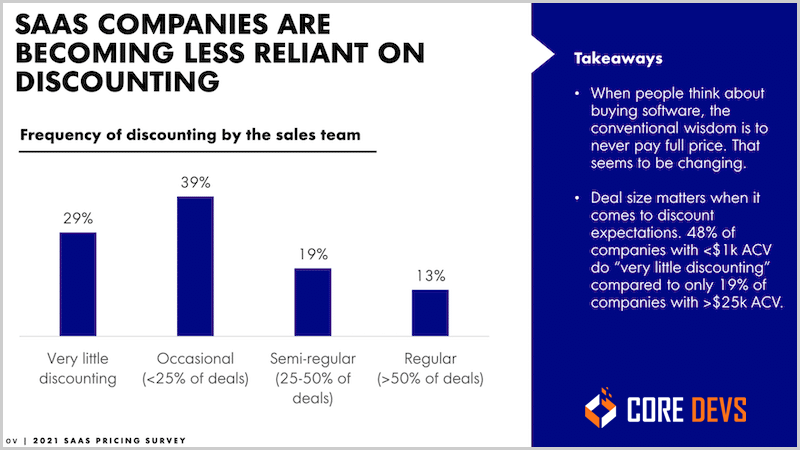
The following image represents the percentage of some of the prominent SaaS sellers selling SaaS with discount strategies and the frequencies of selling –
Why Does SaaS Pricing Matter?
SaaS pricing plays a pivotal role in the success and sustainability of software-as-a-service companies. It extends beyond mere cost determination and delves into the strategic realm, influencing a range of critical business aspects. Here’s a deeper look at why SaaS pricing matters:
1. Revenue Generation
Pricing directly impacts a company’s financial health. Well-calibrated pricing models ensure that the revenue generated covers operational costs, facilitates growth, and drives profitability.
2. Customer Attraction and Retention
Pricing is a potent tool for customer acquisition. It affects a product’s perceived value and affordability, determining whether potential customers choose to explore or commit. Equally crucial, it aids in customer retention by aligning costs with value, reducing the likelihood of churn.
3. Market Differentiation
The SaaS landscape is competitive, and pricing helps distinguish a product in the market. Whether positioning as a premium solution or an economical alternative, pricing sets the stage for how the product is perceived among competitors.
4. Profitability and Innovation
Sustainable pricing guarantees a healthy profit margin, which is essential for continued innovation and investment in product enhancements. It provides the necessary resources to deliver quality service and respond to market demands.
5. Market Entry and Expansion
Pricing flexibility enables businesses to adapt to changing market dynamics. Lower entry-level prices can attract new customers, while tiered plans accommodate varying requirements, supporting expansion into new verticals.
6. Strategic Decision Making
Pricing decisions are integral to strategic planning. They impact resource allocation, growth projections, and marketing efforts. Thoughtful pricing aligns business objectives with actionable plans.
7. Value Communication
The chosen pricing model communicates the product’s value proposition to customers. It clarifies what users can expect and what they’ll pay for, fostering transparency and trust.
SaaS pricing is more than setting a number; it’s a multifaceted strategy that drives financial stability, customer engagement, and market relevance. Carefully crafting pricing models and adjusting them as needed empowers businesses to thrive in a dynamic and competitive SaaS landscape. Learn more about SaaS Marketing strategy to ace your SaaS game ahead.
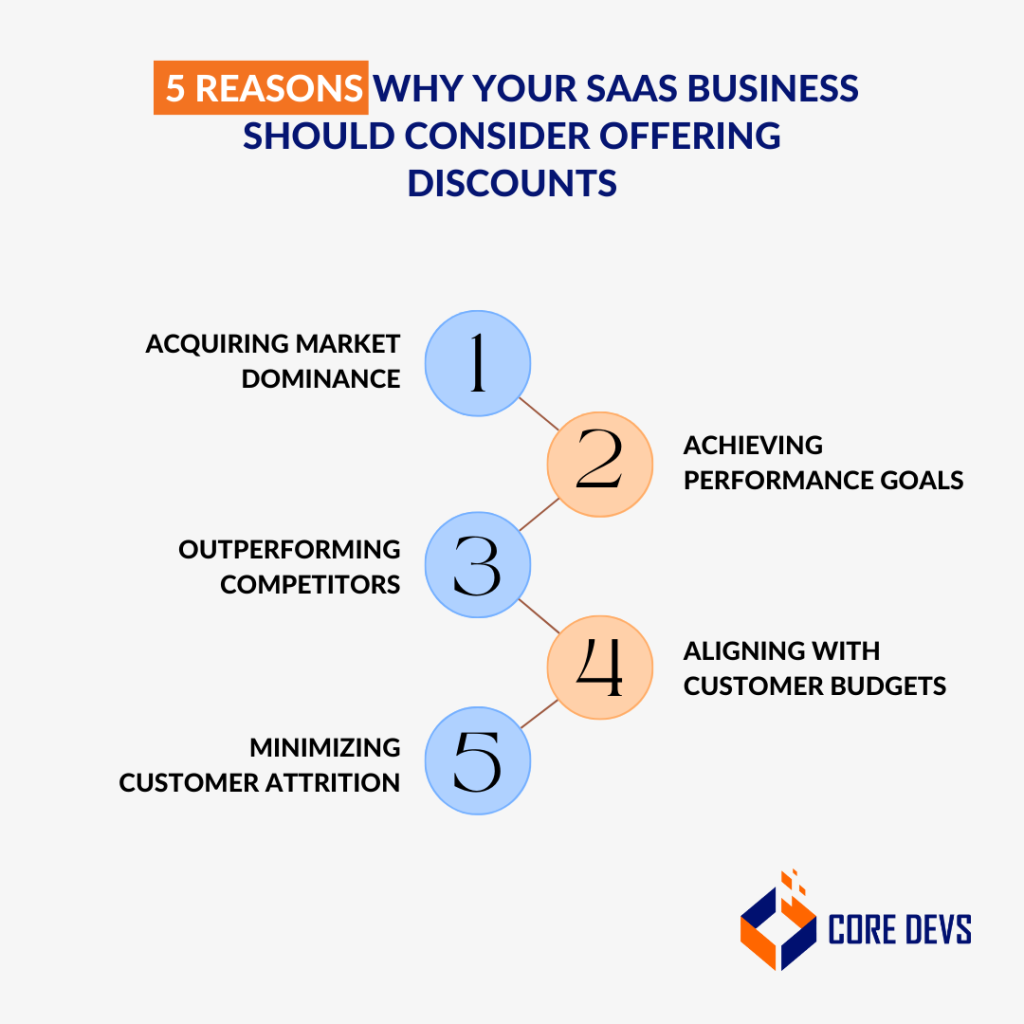
Why Should Your SaaS Business Consider Offering Discounts?
Discounts can be an enticing allure in the SaaS realm, acting as a potent lever to drive various business goals. It’s not just about a reduced price but the strategic implications it carries for a brand.
Let’s determine the rationale behind offering discounts and what they can achieve for your SaaS enterprise.
1. Acquiring Market Dominance
In the ever-evolving SaaS marketplace, companies sometimes adopt discounts as a means to secure market share or establish a strong presence rapidly. This strategy is particularly enticing when:
- Aiming for a strategic customer percentage, say thirty percent of the total market.
- The focus is on changing market dynamics rather than immediate revenue.
2. Achieving Performance Goals
The recent economic disruptions, accentuated by events like the COVID-19 pandemic, have put a strain on financial forecasts and budgets. Offering discounts in such scenarios can:
- Act as a remedy against unmet financial targets.
- Offer a temporary boost, albeit with potential downstream consequences.
3. Outperforming Competitors
In a competitive landscape, standing out may necessitate different discount strategies against various competitors. It’s crucial to remember:
- Tracking varying discounts across competitors can be intricate.
- The importance of tailoring discounts based on competition, ensuring sustainable gains.
4. Aligning with Customer Budgets
Discovering that your SaaS offering surpasses a prospective client’s budget during the sales process can be challenging. Accommodating through discounts can be valuable when:
- The service provision cost is low, allowing for flexibility.
- The client exhibits potential for growth and isn’t merely negotiating.
5. Minimizing Customer Attrition
Ensuring customer longevity or reducing churn is often a priority in SaaS. Offering strategic discounts can lead to the following:
- Increased product dependency, making it indispensable for businesses.
- An initial incentive, like reduced integration costs, may result in prolonged loyalty.
While discounts can be a valuable tool in a SaaS business’s arsenal, it’s imperative to strategize them correctly. Every discount should align with a clear objective, ensuring it contributes to long-term growth and stability rather than just a fleeting advantage.
What Are the Different SaaS Pricing Models?
SaaS pricing models are diverse approaches that companies use to package and charge for their software services. Each model caters to specific business goals, customer needs, and market dynamics. Here are three prevalent SaaS pricing models:

1. Value-Based Pricing
Value-based pricing is a strategic approach that goes beyond traditional pricing models. It ties a product’s price directly to the value it delivers to customers. Instead of fixating on costs or competitors’ prices, value-based pricing focuses on what customers are willing to pay based on the benefits they receive. This approach allows businesses to create customized pricing tiers that cater to different customer segments, reflecting the diverse ways customers perceive value from the product.
Advantages
- Reflects actual value to customers.
- Accommodates diverse user needs effectively.
- Enhances customer loyalty by demonstrating value.
Challenges
- Requires accurate identification of key value metrics.
- Complexity in designing and managing pricing tiers.
2. Cost-Plus Pricing
Cost-plus pricing is a straightforward method where the product’s price is calculated by adding a predetermined profit margin to the total costs of production, distribution, and operational expenses. It ensures that the company covers its costs and earns a profit for each unit sold. This method is particularly useful when costs are well-defined and consistent. However, it might overlook the dynamic market factors that influence how customers perceive the product’s value.
Advantages
- Ensures cost recovery and profitability.
- Straightforward and simple pricing calculation.
- Provides clarity on cost structure.
Challenges
- Ignores customer perceptions of value.
- Potential misalignment with market expectations.
3. Competitor-Based Pricing
Competitor-based pricing is a market-driven approach that involves setting a product’s price based on the prices of similar products offered by competitors. By positioning the product within the context of the competitive landscape, businesses aim to attract customers who are looking for similar solutions at a comparable price. While this strategy offers simplicity and insight into market norms, it can neglect the unique value proposition of the product and may lead to price wars in highly competitive markets.
Advantages
- Simplifies pricing decisions by using market benchmarks.
- Assists in competitive positioning and market entry.
- Attracts price-sensitive customers.
Challenges
- Overlooks the product’s unique value proposition.
- Neglects customization for specific customer needs.
- Can lead to price wars and margin erosion.
These models can be adapted, combined, or customized based on a company’s goals, customer base, and market dynamics. It’s essential to choose a model that aligns with your product’s value, your target audience, and your long-term growth strategy.
How Can You Determine Your SaaS Pricing?
Determining your SaaS pricing involves a systematic approach that aligns with your business goals and market dynamics. Here’s a step-by-step process to guide your pricing strategy:

Step 1: Define Your Value Metric
Identify the core value your product provides to customers. This could be features used, users, data volume, etc. The value metric should reflect the primary benefit customers gain from your SaaS.
Step 2: Analyze Customer Segments
Understand your customer base and segment them based on their needs and willingness to pay. Tailor your pricing tiers to cater to different customer segments.
Step 3: Competitive Analysis
Research your competitors’ pricing models. This helps you position your product competitively and determine the price ranges that align with market expectations.
Step 4: Determine Price Point
Decide on your initial price point based on factors like your value metric, market research, and customer perceptions. Use methods like the Van Westendorp model or the 10x rule to validate your price point.
Step 5: Create Pricing Tiers
Design different pricing tiers that cater to various customer needs. Each tier should offer a distinct set of features and values, allowing customers to choose the most suitable option.
Step 6: Consider Packaging
Structure your pricing tiers with clear and appealing packaging. Ensure that each tier addresses specific customer pain points and provides corresponding solutions.
Step 7: Discounts and Terms
Define your discount strategy, including volume discounts, annual prepayment discounts, and any special promotions. Specify billing cycles and cancellation policies.
Remember, your pricing strategy should align with your company’s goals, value proposition, and the perceived value your product offers to customers.
Which 5 Rules Should You Follow in 2023 to Offer an Effective SaaS Discount?
In the ever-evolving SaaS landscape, mastering the art of discounting is paramount for sustainable growth and customer loyalty. Let’s observe five meticulously crafted rules that will empower you to offer strategic SaaS discounts in 2023, driving revenue while nurturing strong client relationships –

Rule 1: Prioritize Financial Certainty with Prepayments
Ensuring financial stability is the cornerstone of any successful SaaS venture. By embracing strategic prepayments and discounts, you can amplify your company’s fiscal health and secure predictable growth.
Advantages
- Prepayments inject immediate cash flow, fortifying your financial foundation and empowering strategic investments.
- Accurate revenue projections facilitate informed resource allocation, leading to optimized decision-making.
- Predictable income through prepayments mitigates financial uncertainties, creating a stable platform for innovation.
Rule 2: Elevate Brand Recognition through Strategic Partnerships
Strategic discounting can pave the way for lucrative partnerships, enhancing your brand’s visibility and credibility within your industry.
Advantages
- Collaborating with industry leaders builds credibility, leveraging their reputation to enhance your brand’s credibility.
- Testimonials from prominent clients serve as persuasive marketing tools, offering tangible examples of your solution’s effectiveness.
Rule 3: Cement Credibility with References and Testimonials
Transitioning from early adopters to a broader market requires credibility. Discounts help secure references and testimonials that facilitate this journey.
Advantages
- Discounts bridge the gap between early adopters and mainstream customers, fostering adoption among a broader audience.
- Discounts can be tied to future referrals, leveraging satisfied clients to bolster your client base and streamline sales efforts.
Rule 4: Tailored Volume Discounts for Mutual Growth
Volume discounts, when tailored to offer genuine value, can be a potent tool for nurturing client relationships and sustaining growth.
Advantages
- Tailored volume discounts reflect real value gained, promoting fairness and encouraging clients to scale their engagement.
- Value-driven volume discounts create mutually beneficial relationships, fostering loyalty and long-term collaboration.
Rule 5: Collaborative Innovation for Shared Success
Collaborative discounts that fuel joint feature development can enhance your product’s capabilities while cementing customer relationships.
Advantages
- Collaborative discounts allow customers to invest in features that align with their needs, creating a symbiotic partnership.
- Features developed collaboratively can expand your product’s functionality, attracting a wider customer base and driving growth.
Incorporating these five rules into your SaaS discount strategy can be the key to unlocking a harmonious blend of revenue growth, customer satisfaction, and long-term success in the dynamic SaaS landscape of 2023. By carefully aligning these principles with your unique business model, you’ll be poised to thrive in a competitive market while building enduring client relationships.
Wrapping Up
As we navigate the intricate nuances of the SaaS landscape in 2023, an adept SaaS Discount Strategy will be instrumental in distinguishing your brand from the competition. Balancing discounts with sustainable growth isn’t just about short-term gains; it’s about forging lasting relationships, ensuring financial stability, and establishing a brand that resonates with customers. By embracing these strategic principles, you’re not just setting a price – you’re defining value. Remember, in the realm of SaaS, it’s always the right strategy that turns the key to success.

