


Imagine a world where financial transactions are borderless, secure, and efficiently conducted.
A realm where traditional barriers are shattered, and money flows freely across the globe, untethered by intermediaries. This is now possible because of the revolutionary domain of cryptocurrencies!
It’s time to explore the Future of Cryptocurrency and its immense potential to reshape the global financial landscape.
As we dive into the fascinating realm of digital currencies, we’ll decipher their current state, uncover the latest trends in 2023, and gaze into what lies ahead.
Join us as we navigate the Crypto world, paving the way for a decentralized future!
What Is Cryptocurrency?
Cryptocurrency, a revolutionary concept born from the marriage of cutting-edge technology and finance, has captured the world’s imagination. It represents a paradigm shift in how we perceive and interact with money.
Let’s identify the key aspects that define cryptocurrency:
1. Digital Nature
Cryptocurrencies are entirely digital entities, existing only in electronic form. They lack a physical counterpart like traditional coins or banknotes.
2. Cryptography and Security
The name “cryptocurrency” itself reveals the foundation of its security. Advanced cryptographic techniques ensure secure transactions, control the creation of new units, and verify the transfer of assets.
3. Decentralization
Unlike centralized banking systems, cryptocurrencies operate on decentralized networks. The absence of a central authority, such as a government or financial institution, empowers users with greater control over their finances.
4. Blockchain Technology
Most cryptocurrencies leverage blockchain, a distributed ledger technology. This transparent and immutable ledger records all transactions across a network of computers.
5. Mining and Consensus
To validate transactions and add them to the blockchain, some cryptocurrencies employ a process known as mining. It involves solving complex mathematical puzzles, and miners are rewarded with new coins.
6. Limited Supply
Many cryptocurrencies have a capped supply, meaning a fixed maximum number of coins can ever exist. This characteristic often ensures scarcity and potential value appreciation.
Now that you have learned about the characteristics of cryptocurrencies, do you want to know about the working process of cryptocurrencies? Then, checking out our in-depth article on this will surely help!
What Was the State of the Crypto Market in 2022?
The events of 2022 have significantly shaped the cryptocurrency landscape, leading to an uncertain fallout. Unlike previous crypto winters, institutional crypto adoption remains strong as investors adopt a long-term perspective.
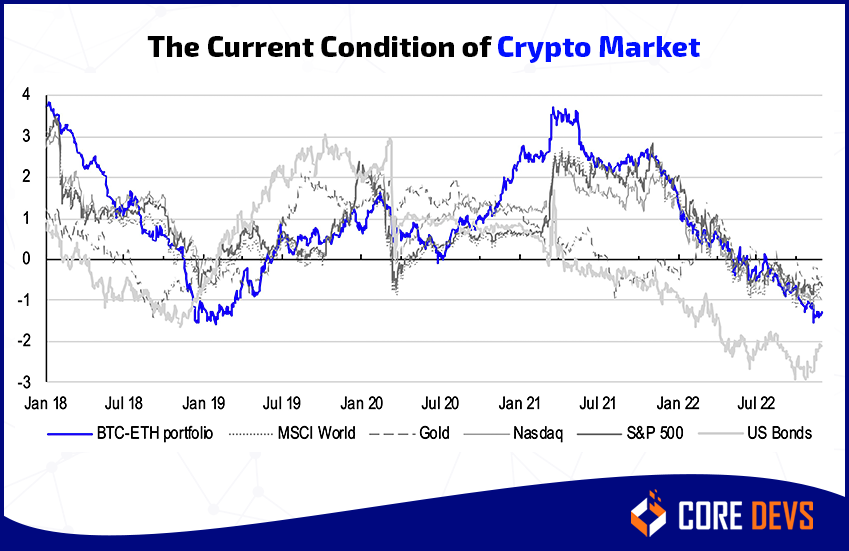
The total market capitalization of cryptocurrencies currently stands at around US$835 billion, down 62% from the peak of $2.2 trillion in 2021. Despite the setback, crypto’s risk-adjusted return outperformed US and global stock indices in 2022, surpassing US bonds.
You can take a look at the graph presented below to have a better understanding –
Regulatory clarity is expected to increase, driven by institutional demands for better governance and standards to enhance accessibility and safety.
What Is the Current State of the Crypto Market?
In June 2023, the cryptocurrency market witnessed a surge as major financial institutions embraced digital assets. Bitcoin and other cryptocurrencies reached new highs, fueled by institutional interest and the launch of EDX Markets.
By closely looking at the image below, you can understand the future growth of the Crypto Market in the upcoming years –

Let’s take a deeper look into this –
1. Major Financial Institutions Embrace Digital Assets
The cryptocurrency market surged in June, with Bitcoin (BTC) and other major digital currencies reaching year-long highs. This rally was fueled by significant financial institutions entering the digital asset space.
BlackRock and prominent U.S. asset managers took steps to secure SEC approval for an innovative Bitcoin exchange-traded fund, signaling a growing interest from institutional players.
2. Launch of EDX Markets
Wall Street heavyweights made a significant move with the unveiling of EDX Markets, a fresh addition to the cryptocurrency exchange landscape. This launch further validates the potential of the crypto market.
The SEC continued its stringent stance on existing cryptocurrency exchanges, filing lawsuits against Coinbase and Binance, reflecting regulatory scrutiny.
3. Monitoring Institutional Crypto Activity
The industry remains vigilant in observing institutional players’ involvement in cryptocurrency. Experts closely track economic factors, including fluctuations in the U.S. economy and interest rate projections.
Despite facing challenges, the crypto market exhibited remarkable resilience, exemplified by Bitcoin’s surge to new 52-week highs exceeding $31,300 in June and substantial gains observed in Ethereum. Noteworthy performances also came from Solana (SOL) and Bitcoin Cash (BCH) in the first half of 2023.
The first half of 2023 demonstrated the cryptocurrency market’s dynamism and resilience. Institutional involvement and new platforms contributed to significant gains in Bitcoin and Ethereum.
As the year progresses, excitement and potential growth continue to drive the industry amid regulatory developments and increasing institutional acceptance. Navigating this landscape with prudence remains essential for a prosperous future for cryptocurrencies.
What Can Be Predicted about the Future of Cryptocurrencies?
Let’s now explore the future of cryptocurrencies, analyzing trends and possibilities that could shape the market –
1. Cryptocurrency Regulation and Mainstream Adoption
As cryptocurrencies gain growing adoption and mainstream interest, more regulatory measures will likely be introduced to govern the space.
This may lead to international coordination in establishing a framework for regulating cryptocurrencies and ensuring compliance with evolving standards.
2. Handover to Established Institutions
Following the significant loss of $2 trillion in market value in 2022, there is a possibility of witnessing a shift in control over crypto technology and blockchain infrastructure towards more regulated and established institutions, as proposed by the World Economic Forum Annual Meeting.
3. Decentralization and Multi-Chain Ecosystems
The future of cryptocurrencies is expected to lean heavily towards decentralization, with a strong emphasis on multi-chain ecosystems.
Industry experts, including Cheng Wang, CEO of Alephium, believe that decentralization will play a pivotal role in shaping the crypto space.
4. Anticipated New All-Time Highs
Based on historical price patterns, it is anticipated that new all-time highs (ATH) might be reached within the next five years for Bitcoin and the entire crypto market cap.
This timeframe could also see the bottom of the upcoming market cycle, setting the stage for the next bull run.
5. Advancements in Blockchain Technology
Continuous evolution in the crypto space will likely lead to improvements in blockchain technology.
For example, the Ethereum Virtual Machine (EVM)-compatible Reef Chain is a promising solution offering fast, scalable, and low-transaction-cost capabilities for decentralized finance (DeFi) applications.
Such advancements eliminate wasteful mining and incorporate efficient on-chain governance.
6. Mass Adoption and Integration Across Industries
Cryptocurrencies are expected to achieve greater mainstream acceptance, increasing adoption and integration across various industries and sectors.
This trend may include more businesses accepting cryptocurrencies as payment and developing new financial products and services based on digital assets.
The future of cryptocurrencies holds exciting opportunities and challenges, impacting the financial landscape worldwide. Embracing these changes is crucial for success in the dynamic crypto space.
What Are the Top 10 Cryptocurrency Trends in 2023?
As we navigate 2023, the future of cryptocurrency looks robust and transformative, with various vital developments changing the dynamics of this digital ecosystem.
Let’s take a look at the more outstanding picture –
1. Cryptocurrency Regulation
Governments worldwide have been reassessing their stances on cryptocurrencies. Regulation, while challenging for the decentralized ethos of cryptocurrencies, is becoming an inevitable part of the future of crypto.
Cryptocurrency regulation ensures security and transparency and facilitates integration into existing financial infrastructures, making the market attractive to new users.
2. Crypto ETF Approval
The stock market has been experiencing a new wave of integration with cryptocurrencies. The approval of Crypto Exchange-Traded Funds (ETFs) by stock advisors signifies the acceptance of digital assets in traditional investment platforms.
This not only bolsters the credibility of crypto but also opens up a new avenue for investing.
3. Bitcoin to Remain Under Pressure
As the frontrunner in cryptocurrency, Bitcoin has had to navigate through intense scrutiny, rigorous regulation, and mounting competition from alternative digital currencies.
Yet, despite these challenges, Bitcoin’s enduring resilience, backed by its widespread acceptance, suggests that it will remain a key player in the crypto sector for years to come.
4. NFT Market Growth Expected to Continue
Non-fungible tokens (NFTs) have rapidly carved a niche within the blockchain sector. With their deep ties to the arts, gaming, and collectibles, NFTs are revolutionizing how value and ownership are perceived digitally.
Their market is poised for further growth, expanding beyond art as they redefine digital ownership and authenticity.
5. Web 3.0 to Enter the Mainstream
The future of cryptocurrency is closely tied to the evolution of the internet. Web 3.0, with its promise of a decentralized and intelligent web, is seeing mainstream adoption.
Blockchain development and cryptocurrencies are central to this paradigm shift, offering users greater control and security over their digital identities and assets.
6. Crypto Warfare
With the rise of state-backed cryptocurrencies, nations are starting to realize the strategic potential of crypto. As blockchain and crypto become key areas of national interest, we may see more state-led initiatives aimed at controlling or influencing these technologies.
These developments could define the future of crypto on a global scale.
7. Enhanced Corporate Crypto Features, More Dynamic Use Cases
Businesses increasingly adopt cryptocurrency for various use cases, from processing payments to managing supply chains. Enhanced corporate crypto features and app development make it easier for companies to integrate blockchain into their services.
As companies continue to invest in crypto, its applications and potential returns are expected to grow.
8. Ethereum 2.0 Reaching Its Full Potential
Ethereum 2.0, Ethereum’s much-anticipated upgrade, is projected to reach its zenith in 2023.
With this upgrade, the platform’s shift to Proof-of-Stake (PoS), and the introducing of sharding techniques, Ethereum 2.0 promises significant enhancements in scalability and energy conservation, making it a formidable force in the crypto world.
9. Increase in Layer 2 Smart Contracts
Layer 2 solutions, which operate on top of existing blockchains, are becoming more popular as they offer faster and cheaper transactions.
Smart contract use on Layer 2 is expected to increase, bringing a whole new level of utility and functionality to the blockchain and the future of cryptocurrency.
10. Crypto to Continue Driving the Adoption of Green Energy
The crypto sector’s energy consumption remains a topic of intense debate and concern. Yet, the quest for sustainable solutions spearheads innovation in renewable energy methodologies.
Green cryptocurrencies and energy-efficient blockchain solutions are catalyzing a move towards sustainable energy sourcing, ensuring a more eco-friendly trajectory for the digital asset industry.
As the boundaries of technology and finance continue to blur, cryptocurrencies remain at the forefront, pushing the envelope on innovation and redefining traditional notions of value, ownership, and trust.
The future of cryptocurrency is looking bright, with significant potential to shape our digital lives.
Which 10 Industries Are Gearing up for Decentralization in the Near Future?
As we venture further into the digital age, various industries are harnessing the power of blockchain and decentralization.
From finance and media to healthcare and public administration, these sectors are gearing up for substantial transformations, heralding a new era of efficiency, transparency, and inclusivity.
This decentralized future promises to reshape our everyday experiences in profound ways.
The image here can give you a precise idea about some of these industries’ decentralization –

Let’s discover more about these industries –
1. Finance
DeFi is a groundbreaking sector at the forefront of decentralization. It operates on public blockchain networks, enabling users to access financial services like lending, borrowing, and trading without traditional intermediaries.
The primary objective of DeFi is to create a more inclusive, efficient, and secure financial ecosystem.
Outcomes
- Direct peer-to-peer financial transactions.
- Increased access to financial services for underserved populations.
- Enhanced security through blockchain technology.
2. Media and Entertainment
The media and entertainment industry is experiencing a profound transformation by adopting blockchain technology and Non-Fungible Tokens (NFTs).
This technological shift empowers content creators with unprecedented ownership rights, transparent royalty distributions, and innovative ways to engage with their audience.
Outcomes
- Creators can directly connect with their fans and supporters.
- Fair and transparent royalty payments.
- Increased protection of intellectual property rights.
3. Supply Chain Management
Blockchain and decentralization are revolutionizing supply chain management by introducing greater transparency, accountability, and traceability into the movement of goods and products.
This transformation has the potential to significantly reduce instances of counterfeiting and fraud while ensuring ethical sourcing practices.
Outcomes
- Enhanced visibility into product journeys.
- Reduction in counterfeit products and fraudulent activities.
- Ethical sourcing and sustainability initiatives are more easily verifiable.
4. Healthcare
The healthcare sector is shifting towards decentralization, which promises improved data security, heightened patient privacy, and efficient management of patient records.
Blockchain technology enables the creation of decentralized health records, fostering interoperability and giving patients greater control over their own medical data.
Outcomes
- Enhanced security and privacy of patient data.
- Seamless sharing of health information among healthcare providers.
- Greater patient autonomy and control over health records.
5. Real Estate
Blockchain technology holds the potential to decentralize real estate transactions, revolutionizing the buying and selling of properties by eliminating intermediaries, reducing costs, and expediting processes.
It also facilitates the establishment of decentralized property registries and enables fractional property ownership, leading to more transparent and efficient transactions.
Outcomes
- Streamlined real estate transactions with reduced paperwork and costs.
- Decentralized property registries for increased transparency.
- Accessibility to fractional ownership opportunities.
6. Education
Decentralization is poised to democratize education, making it more accessible and affordable.
Blockchain technology can be harnessed to create decentralized and verifiable records of academic qualifications, significantly reducing fraud and streamlining recruitment and admissions processes.
Outcomes
- Verifiable and tamper-proof academic records.
- Simplified and efficient recruitment and admissions procedures.
- Greater accessibility to educational opportunities for learners worldwide.
7. Energy
Peer-to-peer (P2P) energy trading is a sector primed for decentralization, enabling consumers to generate their renewable energy and trade surplus power directly with others through decentralized networks.
This shift empowers individuals to take control of their energy production and consumption, promoting sustainability and reducing reliance on centralized energy providers.
Outcomes
- Empowerment of individuals to generate and trade renewable energy.
- Increased sustainability and reduced carbon footprint.
- Enhanced resilience in energy distribution.
8. Internet Infrastructure
The concept of Web 3.0 envisions a more decentralized Internet where users have greater control over their data and digital experiences.
This transformation could involve decentralized social media platforms, data storage solutions, and even decentralized web browsing, offering users enhanced privacy and security.
Outcomes
- Greater user control over personal data.
- Enhanced privacy and security in online interactions.
- Reduced dependence on centralized internet platforms.
9. Public Administration
Blockchain technology is revolutionizing public administration by decentralizing government systems and processes.
This innovation enhances efficiency, transparency, and trust in public services, extending to voting systems, public records management, and identity verification.
Outcomes
- Enhanced efficiency and transparency in government operations.
- Trustworthy voting systems with reduced potential for fraud.
- Secure and interoperable public records management.
10. Legal Industry
Smart contracts are reshaping the legal industry by enabling the automatic execution of agreements when predefined conditions are met.
This streamlines contract management and eliminates the need for intermediaries, promoting efficiency and reducing costs.
Outcomes
- Efficient and automated contract execution.
- Reduced reliance on intermediaries in legal processes.
- Cost savings and increased transparency in legal transactions.
These industries gearing up for decentralization will significantly change how businesses operate and how users interact with these services. The overall impact of these transformations could lead to more inclusive, efficient, and transparent systems.
Why Choose Core Devs for a Crypto Solution?
Core Devs stands out as a beacon of innovation and reliability in the fast-paced realm of cryptocurrency and blockchain. We have honed our expertise to address the diverse challenges of the ever-evolving crypto world.
Dive into our services, each designed with precision and a deep understanding of the crypto landscape, to discern how CoreDevs can elevate your business to new heights.
Blockchain Development
Our blockchain development expertise extends to crafting both public and private blockchains. With a deep understanding of blockchain protocols and algorithms, we design and deploy customized solutions for various industries, enhancing transparency, security, and scalability.
How This Service Can Benefit You
- Improved data transparency and security
- Scalable solutions tailored to your industry
dApps Development
Our dApps development team specializes in creating user-friendly, feature-rich decentralized applications. These seamlessly integrate with blockchain networks across finance, supply chain, and healthcare sectors.
How This Service Can Benefit You
- Enhanced user engagement and experience
- Integration with diverse industry domains
Smart Contract Development
Our smart contract development ensures optimal operational efficiency and accuracy. We code and deploy secure, reliable smart contracts, aligning them with your business processes and various blockchain platforms.
How This Service Can Benefit You
- Streamlined operations and reduced errors
- Secure, adaptable smart contracts
SaaS Development
Our SaaS solutions cater to multiple industries, leveraging blockchain’s advantages like data immutability and transparency. We prioritize an intuitive user experience and adaptability to evolving business needs.
How This Service Can Benefit You
- Improved data security and immutability
- User-friendly, adaptable solutions
Trading Automation
For crypto trading enthusiasts, our trading automation tools implement sophisticated strategies to optimize trading activities. These tools execute trades based on predefined parameters, reducing manual intervention and minimizing errors.
How This Service Can Benefit You
- Enhanced trading efficiency and strategy execution
- Reduced human error in trading activities
Web Development
Our web development services excel in creating websites that seamlessly integrate crypto-related features. From intuitive user interfaces to robust backend systems, our web solutions offer a holistic user experience, ensuring responsiveness and security for both desktop and mobile users.
How This Service Can Benefit You
- Responsive, secure web platforms
- Enhanced user engagement and crypto integration
Data Scraping & Filtering
In the data-driven crypto world, we provide data scraping and filtering services to extract valuable insights from diverse sources. Our experts employ advanced tools and techniques to collect, process, and analyze relevant data points, empowering your business with accurate and up-to-date information.
How This Service Can Benefit You
- Access to valuable insights from diverse data sources
- Informed decision-making and competitive advantage in the crypto landscape
Our dedicated team of experts is committed to empowering your business with innovative solutions that leverage the transformative potential of blockchain technology.
Explore the possibilities with CoreDevs today!
Wrapping Up
Both thrilling advancements and intricate challenges mark the future of cryptocurrency. As this digital realm advances, it’s not just about transactions but a reimagining of financial paradigms.
New applications are emerging, from decentralized finance to unique digital assets, stretching the boundaries of how we perceive value.
As regulatory frameworks adapt, they’ll provide clearer directions, ensuring safety while nurturing innovation.
The potential implications of cryptocurrency, from transforming global trade to democratizing financial access, make it clear: we stand at the cusp of a transformative era, with the digital currency revolution promising a reshaped global landscape.

